


Schedule a talk with one of our advisors to learn more about Summitry and how we can help you get a foothold on your financial life. For career opportunities please visit careers at Summitry.
Team
Insights
Pages
- Let's Talk
- Phone / Directions
Sustainable Income

Sustainable Income Strategy – June 30, 2026
Risk appetite returned in force during the second quarter of 2026. As tensions in the Middle East eased and oil prices retreated to pre-conflict levels, investors resumed their enthusiasm for equities generally and for artificial intelligence themes in particular. The S&P 500 Index gained +15.2%, its strongest quarterly advance since 2020. Dividend-paying stocks participated in the rally, though as one would expect in a quarter led by the market’s fastest growers, they did not lead it. The S&P 500 Dividend Aristocrats Index, so named because the index is comprised of companies that have consistently increased their dividend payments for at least 25 consecutive years, returned +6.7% in the period.
Quarters like this illustrate why we evaluate a lower-volatility strategy over full market cycles rather than any single period. Because the Aristocrats declined far less than the broad market earlier in the year, they have essentially kept pace with the S&P 500 through the first six months of 2026 (+9.3% versus +10.2%) while subjecting investors to a much smoother ride along the way. Losing less in declines is a quiet but powerful contributor to long-term compounding, and it is central to the design of this strategy.
The Sustainable Income Strategy performed well against this backdrop. A composite of accounts invested in the strategy returned +6.94% and +6.61%, gross (before) and net (after) fees, during the second quarter, well ahead of the +4.90% return of its blended benchmark (70% S&P 500 Dividend Aristocrats Index / 30% Bloomberg Aggregate Bond Index). Notably, the composite’s gross return exceeded that of the all-equity Aristocrats index itself, as strong stock selection more than offset the drag from the portfolio’s bond allocation in a rising equity market. Here is the record for the Sustainable Income Composite since inception (please see performance disclosure at end of this note).1
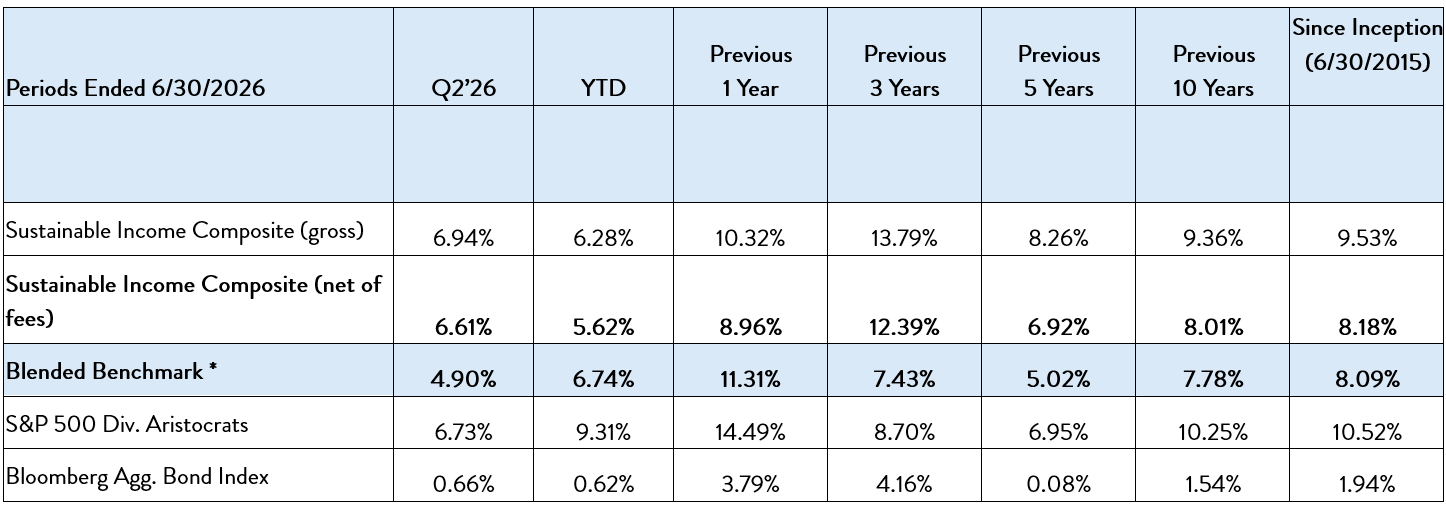
* Blended Benchmark: 70% S&P 500 Dividend Aristocrats/30% Bloomberg Aggregate Bond Index
Individual client account performance varied around this composite average, reflecting their specific mix of stocks, bonds, preferred stocks, and bond ETFs. As always, we remind you that returns from this strategy and performance relative to our benchmark will ebb and flow over time, as do the stock and bond markets in which this strategy invests.
Dividend Growth
Five companies in the Sustainable Income portfolio increased their dividend in Q2: JNJ (+3.1%), OTIS (+4.8%), PG (+3.0%), RTO (+3.0%), and VZ (+2.6%). While headline inflation was temporarily elevated this spring by the surge and retreat in oil prices, most of these increases are ahead of core inflation, meaning that the purchasing power of this income stream is growing in real terms. This is precisely the objective of the Sustainable Income strategy. No companies in the portfolio decreased their dividends this quarter, although Nintendo has signaled a lower payout for its current fiscal year (see Top Detractors below).
Of the many factors that we consider when selecting companies to own in the Sustainable Income portfolio, the capacity and commitment to pay sustainable and growing dividends are among the most important. The capacity to pay growing dividends is derived from earnings growth and strong balance sheets. The commitment comes from various company managements and boards of directors who choose to share surplus earnings with shareholders. Not every great company will pass through earnings in the form of a dividend, which is a reasonable choice if the earnings can be reinvested in the business in initiatives that promise high returns on investment. Those stocks will not qualify for the Sustainable Income strategy, but they may be held in other strategies managed by Summitry. But when a management team cannot redeploy cash in a manner that will generate a high return within the company’s operations, we would prefer they remit that cash to shareholders in the form of a dividend. These are ideal stocks for Summitry’s Sustainable Income portfolio strategy.
Q2’26 Top Contributors
- Cisco (CSCO) returned +53.4% in the quarter. Demand for Cisco’s networking equipment tied to the AI buildout is expected to make this its fastest-growing year since 2010. Momentum is accelerating, with orders from cloud hyperscalers expected to reach $9 billion this fiscal year, up from just $2 billion last year.
- Caterpillar (CAT) returned +50.0% in the quarter, continuing its strong performance over the last several years. Revenue in Q1 grew by +22%, led by Construction Industries (+38%) and Power & Energy (+22%). Tariffs are expected to be a $2.2 to $2.4 billion headwind this year, partially offset by higher pricing. The Power Generation business remains a standout, growing by +41% in the quarter. Informed by this strong demand, management raised its FY26 growth target from roughly +7% to low double digits, and its medium-term growth target from 5%-7% to 6%-9%.
- Taiwan Semiconductor (TSM) returned +41.1% in the quarter as the business continues to demonstrate the dominance of its hard-earned monopoly at the leading edge of semiconductor manufacturing. Demand for AI accelerators remained insatiable and led management to raise its growth forecasts for these products through 2029. We believe TSMC’s central position in the AI revolution will continue to drive its results for the foreseeable future.
Q2’26 Top Detractors
- Nintendo (NTDOY) returned -26.4% in the quarter as investors worried that memory chip shortages could hurt sales. We view this as a manageable issue. We think Nintendo has sufficient memory supply, and we do not believe higher memory costs should have a meaningful long-term impact on margins or profits. While management projects a lower dividend this year due to the memory impact on margins, we believe Nintendo is well-positioned to grow earnings, and thus dividends, in the coming years.
- Verizon (VZ) returned -14.4% in the quarter on news that Starlink is considering competing by offering its satellite service directly to mobile consumers. We believe this is unlikely to happen, as it would require some terrestrial infrastructure investment to maintain stable reception and would certainly require investments in labor to service customers, both of which would be a drag on Starlink’s margins. Our current thinking remains that Starlink is likely to be a technology partner without competing directly with Verizon, AT&T, and T-Mobile.
- McDonald’s (MCD) returned -12.4% in the quarter even as the company delivered +3.9% comparable sales growth, lapping several quarters of flat to negative growth last year. It has been a tough year for food and beverage companies in general, as lower-income consumers continue to face inflationary pressures. With its superior scale and renewed focus on affordability and hot categories, we expect McDonald’s to perform better than most in this environment.
Fixed Income Securities
The Sustainable Income portfolio has traditionally held approximately 30% of its assets in bonds and similar securities that offer a fixed yield. Their primary purpose is to increase the overall portfolio yield rather than offer long-term appreciation potential. Bond returns were modestly positive in the second quarter, with the Bloomberg Aggregate Bond Index gaining +0.66%. Interest rates were volatile mid-quarter as the spring surge in oil prices temporarily lifted reported inflation, but yields stabilized as energy prices normalized. Once again, bonds delivered on their typical promise of stable cash flows and relatively stable valuations.
Key Actions
Exit: AT&T (T)
Earlier in the quarter, we exited our position in AT&T (T) after a strong two-year run following the company’s exit from the media business and subsequent efforts to simplify operations under the leadership of CEO John Stankey. AT&T has delivered robust postpaid phone subscriber growth in the last several years, at the expense of Verizon, but recent results suggest Verizon is back on its feet and we expect market share to stabilize going forward. Moreover, AT&T is entering a period of elevated capital expenditures over the next five years as it invests to expand its network, which will likely pressure free cash flow generation.
New positions: Otis Worldwide (OTIS) and Mastercard (MA)
Otis is a global leader in the manufacturing and servicing of elevators and escalators for commercial and residential buildings. Otis operates two segments: New Equipment and Services. The Services segment is a stable, high-margin business that accounts for the majority of Otis’s value. The stock has been under pressure due to weakness in the New Equipment market in China and Services revenue lagging some peers. Our research suggests China is quickly transitioning from a New Equipment market to a Services market, which should stabilize revenue growth, and the company is addressing its Services gap by hiring additional field technicians. Roughly 40% of the global installed base of elevators is over 15 years old, an age at which repairs and upgrades are required, which should support continued Services growth for Otis in the coming years.
Mastercard operates alongside Visa, which we already own in the portfolio, in an oligopoly featuring one of the best business models we have ever analyzed. Both stocks have come under pressure due to concerns about displacement by stablecoin offerings and financials generally being out of favor in this AI-driven market. Many have tried to disrupt Mastercard and Visa’s networks in the past. None have succeeded, and we believe the same will likely prove true of stablecoins. Thus, we are taking advantage of the weakness in the stock to add Mastercard to the portfolio.
Conclusion
The Sustainable Income strategy has produced respectable returns in volatile markets and over a market cycle. We believe Sustainable Income remains a good choice for clients who seek growth of income over time and reduced portfolio volatility, while retaining some opportunity for capital appreciation.
About Summitry’s Sustainable Income Strategy
Many clients ask us to address the tradeoff between their need for current income and desire for capital growth. Bonds alone are unlikely to generate sufficient returns to preserve purchasing power over the long-term, but stocks subject the investor to greater volatility. The power of long-term compounding of wealth provided by the equity markets can be lost if volatility compels clients to liquidate securities during market drawdowns. This concern typically grows more acute as clients age and time horizons compress.
To meet this challenge, we devised a portfolio strategy in 2015 that attempts to balance the need for reduced volatility with a desire for capital appreciation. Our solution is a diversified portfolio primarily consisting of blue-chip companies that pay regular and growing dividends out of surplus cash flow. We believe these companies generate earnings beyond what is needed to grow their businesses. This surplus allows management to raise their dividend payouts over time. We call this our Sustainable Income strategy. To learn more, we gave a behind-the-scenes look at our Sustainable Income strategy here.
Summitry’s Dividend Growth Strategy
Summitry’s Dividend Growth Strategy is comprised 100% of dividend-paying equities and is made available to clients who wish to have exposure to the income generation and total return opportunity that is offered from the equities held in the Sustainable Income strategy, but without the exposure to SI’s bond and preferred stock holdings. Your Financial Advisor can help you decide if this is a useful and appropriate strategy given your personal financial circumstances.
This commentary reflects the opinions of Summitry, LLC and is for informational purposes only. Nothing herein constitutes investment advice or any recommendation that any particular security, transaction, or strategy is suitable for any specific person. The securities identified do not represent all the securities purchased, sold, or recommended for client accounts. Past performance does not guarantee future returns. Investing involves risk. The reader should not assume that an investment in the securities identified was or will be profitable. An index is a hypothetical portfolio of securities representing a particular market or market segment and is used as an indicator of the change in the securities market. Indexes are unmanaged, do not incur fees and expenses, and cannot be invested in directly. For Top Contributors and Top Detractors, the investment characteristics presented are shown on a gross basis and do not reflect the deduction of advisory fees, trading costs, custodial fees, or other costs that clients have paid or would have paid. The deduction of fees and expenses reduces investment returns and would also affect the investment characteristics presented. The criteria used to select the presented investments are based on the top contributors to performance for the period and top detractors to performance for the period. Other investments held during the same period may have performed differently, including experiencing losses. For a complete list of holdings during the period discussed, please contact your Advisor.
1 Sustainable Income Composite includes all Sustainable Income accounts with a long-term target of 70% investment in primarily U.S. dividend paying stocks and 30% investment in income producing securities which include bonds and/or ETFs, preferred securities, REITs and MLPs. The allocation among asset classes generally may vary around this long-term target by plus or minus 10 percentage points and we may hold cash balances. The primary objective of the strategy is to produce monthly income that grows at a rate faster than inflation through a portfolio principally invested in equities, and a secondary objective to participate in the long-term appreciation of the equity securities held. Bonds and preferred stocks are selected to add stability to the portfolio’s cash flow. Summitry employs a value-based investment strategy focusing on high-quality multi-national businesses that can be purchased at a discount to their estimate of intrinsic value. The benchmark for this composite is a blended benchmark consisting of 70% S&P 500 Dividend Aristocrats Index, and the Bloomberg Aggregate Bond index (30%) (Formerly Barclays Capital Aggregate Bond Index) and is rebalanced monthly. After March 31, 2020, the equity portion of the blended benchmark was replaced from the S&P 500 Index to the S&P 500 Dividend Aristocrats Index. Summitry believes this most closely represents the strategy pursued in the equity allocation. Anytime the individual components are shown, should be considered supplemental information. The minimum account size for this composite is $250 thousand. The U.S. Dollar is the currency used to express performance. Returns are presented net of management fees and include the reinvestment of all income. Net performance is calculated by reducing the gross performance by the model fee of 1.25% applied monthly. The inception and creation of the Sustainable Income Composite was on June 30, 2015.
