Schedule a talk with one of our advisors to learn more about Summitry and how we can help you get a foothold on your financial life. For career opportunities please visit careers at Summitry.


AI and the Future of Coding and SaaS
The ongoing adoption of AI has created an uncomfortable reality for many tech professionals and investors. For the first time in decades, software engineers face legitimate questions about job security, while investors in software-as-a-service businesses (“SaaS”) watch their holdings lose 20% to 50% of their value in a matter of months. The release of Anthropic’s Claude Co-Work in January sparked a fresh wave of selling, with some SaaS names down over 20% in just days.
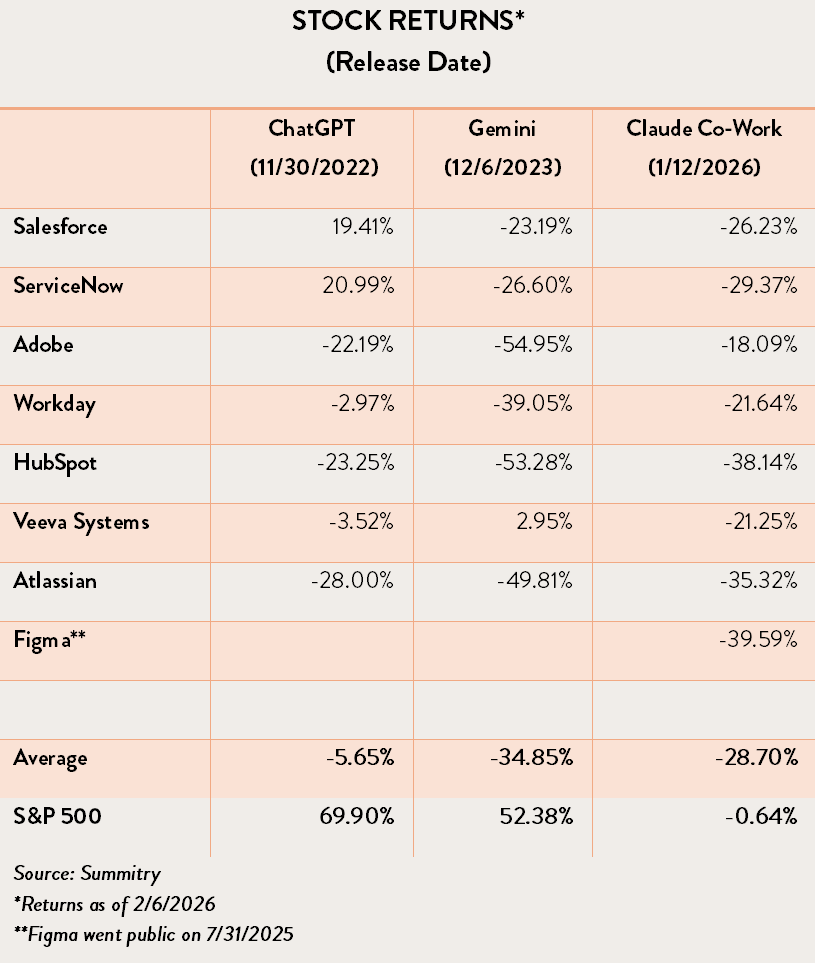
For many of our clients, this is a double whammy, as they often hold concentrated positions in these companies while working in the very roles that AI now threatens to automate.
Will AI Replace Software Engineers?
Companies across the tech landscape now regularly report what percentage of their code is written by AI, and that number keeps climbing.
Data from Microsoft Research, based on studies of GitHub Copilot usage, shows that developers using AI coding assistants complete programming tasks approximately 55% faster than those who do not (Microsoft Research, The Impact of AI on Developer Productivity).¹ Some companies now report that over 50% of new code commits are AI-generated, and several firms in our own portfolio are reporting comparable trends.
We look at coding productivity that Sundar mentioned in the past, our -- about 50% of our codes are written by agents, coding agents, which are then reviewed by our own engineers."
Alphabet
Q4 2025 Earnings Call
...we're elevating individual contributors and flattening teams. We're starting to see projects that used to require big teams now be accomplished by a single, very talented person."
Meta
Q4 2025 Earnings Call
Our intention is for agents to perform wide-ranging complex multistep tasks by organizing a trip or setting the lighting, temperature and music ambience in your house for dinner guests or handling complex IT tasks to increase business productivity. "
Amazon
Q1 2025 Earnings Call
The trajectory is clear. AI is becoming integral to software development. But clear trends don’t always lead to predictable outcomes. The future of software engineering sits somewhere between two dramatically different scenarios:
- The bear case: full automation displaces most coding jobs. AI tools evolve from assistants to autonomous developers. Companies that once employed teams of 50 engineers now need 5 or less to oversee AI agents. Compensation falls. Career paths narrow. Employees displaced.
- The bull case: AI dramatically expands the scope and scale of what software can do. Companies that couldn’t afford custom software suddenly can. Products that took years to build take months. AI unlocks so many new use cases that demand for those who can operate AI coding tools explode. In this scenario, coding professionals, after a period of adaptation and learning of new AI tools, flourish.
History offers examples of both outcomes. The industrial revolution displaced millions of manual laborers. But it also created entirely new categories of work. ATMs didn’t eliminate bank tellers. Banking employment actually increased as branches became cheaper to operate and banks opened more of them. And spreadsheets didn’t eliminate accountants but rather expanded what they could accomplish.
Which pattern will AI follow? We don’t know, and anyone claiming certainty is guessing. What we do know is that the most adaptable professionals will fare better than those who resist change. Learning to work effectively with AI tools, rather than competing against them, seems prudent regardless of how this unfolds.
The SaaS Selloff: A Business Model Under Pressure
The selloff in SaaS stocks tells a different but related story. Over the past year, the typical SaaS company has underperformed the broader market by more than 50%. Some former high-fliers have lost two-thirds of their value. The question investors are grappling with: does AI destroy the traditional SaaS business model?
The classic SaaS model is elegant. A company builds a user interface layer (“UI”) that automates business workflows by applying logic to data stored in an attached database which serves as the organization’s system of record. Users log in, click through screens, and accomplish tasks more efficiently than manual processes allowed. Companies pay per seat, prices rise over time, switching costs keep customers locked in, and profit margins expand as the business scales.
AI threatens nearly every element of this model. If AI agents can execute workflows directly with simple commands such as “schedule the meeting,” “reconcile the invoices,” “update the CRM”, what’s the value of the UI layer? Does the underlying database become more valuable as the sole source of truth, or less valuable if AI can orchestrate multiple data sources and access unstructured data? Can software companies still charge per seat when workflows are executed by agents rather than human users? And does AI lower barriers to entry and reduce switching costs, inviting new competition into markets that seemed impenetrable just months ago?
The market is wrestling with the possibility that companies once considered “wide moat” businesses with durable competitive advantages might face intensifying competition and margin pressure, and in the worst case scenario, displacement.
Our Response: Proceed with Caution
We’re not sold on the doomsday scenarios, but we’re not complacent either. There are multiple paths forward for the SaaS industry, and we highly doubt that all the incumbents will successfully adapt to an agentic world. Some will reinvent themselves. Many will fade, and some will fail.
We’re actively looking for opportunities in this dislocation. Periods of uncertainty often create the best investment opportunities, as fear drives prices below intrinsic value. But we’re proceeding with caution. When the fundamental business model is in question, traditional valuation frameworks become less reliable. A company trading at 15 times earnings might look cheap, unless those earnings are set to fall.
Our approach remains consistent with our long-term investment philosophy: we’re looking for competitively advantaged businesses with financial strength and management quality to adapt to changing circumstances. But in the current environment, we’re placing even greater emphasis on adaptability. Can management articulate a clear vision for how their business survives and thrives in an AI-driven world? Are they investing appropriately? Do they have the financial resources to make the transition?
Why Summitry Owns Salesforce
Salesforce is our only pure-play SaaS business in our client portfolios, and we think that position is worth explaining given industry headwinds.
We own Salesforce because the company is making massive investments in AI and has a credible path to adapt to an agentic world. Management has integrated AI throughout their platform and is building tools that allow customers to deploy AI agents within Salesforce’s ecosystem. They’re betting that even if the traditional UI layer gets disrupted, their position as the system of record for customer relationships remains valuable – perhaps even more valuable in a world where AI agents need trusted data to operate effectively.
That doesn’t mean Salesforce is risk-free. The company faces the same uncertainties as every SaaS business. But we think the combination of their market position, financial resources, and strategic focus on AI gives them a strong chance of emerging as a winner. We’re watching closely and are ready to change our thinking as events unfold.
Concentrated Positions: An Overdue Planning Conversation
If you’re holding a concentrated position in a SaaS company facing these headwinds, or if you work for one of these companies and your income is tied to its fortunes, now is the time to revisit your financial plan.
Diversification has always been important, but it becomes critical when the fundamental outlook for a sector is uncertain. We’ve worked with many clients over the years to reduce concentrated positions in ways that balance tax efficiency, liquidity needs, and risk management. Sometimes that means systematic selling over time. Sometimes it involves hedging strategies. Sometimes it requires accepting a tax bill today to avoid potential wealth destruction tomorrow.
There’s no one-size-fits-all answer. But the conversation is worth having. We can model different scenarios, stress-test your financial plan against various outcomes, and help you make informed decisions about when and how to reduce risk. Whether AI ultimately expands opportunity or compresses it, whether a SaaS business adapts or fades, and how to respond as an investor all depend on context, timing, and individual circumstances. We explore this idea in more detail in this blog post on why the right financial decision is often situational rather than universal.
Conclusion
AI is transforming both how software is built and how software businesses operate. For tech professionals, this creates genuine uncertainty about career trajectories. For investors in SaaS companies, it raises fundamental questions about business models that seemed unassailable just months ago.
The range of possible outcomes is wide, so our approach is to remain disciplined, look for opportunities where fear has pushed prices too low, and help our clients navigate the uncertainty with a robust financial plan.
- Microsoft Research. The Impact of AI on Developer Productivity: Evidence from GitHub Copilot.
https://www.microsoft.com/en-us/research/publication/the-impact-of-ai-on-developer-productivity-evidence-from-github-copilot/
The securities identified and described do not represent all of the securities purchased, sold or recommended for client accounts. The reader should not assume that an investment in the securities identified was or will be profitable. The opinion contained herein are subject to change without notice and contain forward looking views which may not be accurate.
GET THE NEXT SUMMITRY POST IN YOUR INBOX: