Schedule a talk with one of our advisors to learn more about Summitry and how we can help you get a foothold on your financial life. For career opportunities please visit careers at Summitry.


Every generation of investors encounters a technology so transformative that it seems to bend the rules of valuation. In our lifetime, it happened with the internet. Before that, it was telecommunications networks, personal computers, and before all of that, the railroads. Today, it is artificial intelligence, and the pattern is, once again, deeply familiar.
At Summitry, we believe AI is genuinely transformative. The technology is real, the productivity gains are real, and the companies building this infrastructure are, in many cases, exceptional businesses. None of what follows is an argument that AI doesn’t matter. It is an argument that the price at which excitement gets priced into assets matters enormously, and that history offers a useful guide.
The Anatomy of a Hype Cycle
A research firm called Gartner conceived a framework decades ago called the hype cycle. The model describes how emerging technologies move from early discovery through a “peak of inflated expectations,” marked by soaring asset prices and bold assumptions about market size, before falling into a “trough of disillusionment” when the gap between expectation and reality closes, often sharply.
The framework has proven remarkably durable. Railroads in the late 19th century. Telecom fiber in the late 1990s. The dotcoms themselves. In each case, the underlying technology was legitimate and went on to reshape the economy. In each case, the fervor of the early cycle led to overcapitalization, redundant infrastructure, and ultimately, painful corrections for investors who paid peak prices.
We believe AI is currently somewhere on the upslope of that first phase, and probably closer to the peak than to the beginning.
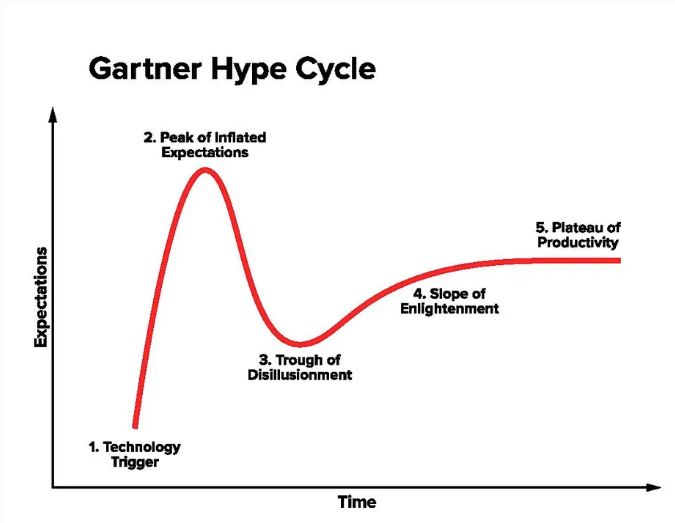
Source: Gartner
Echoes of the Dot-Com Era
The dot-com era offers particularly instructive lessons because the parallels to today are so close. In the late 1990s, a complex web of relationships among internet companies accelerated adoption of a genuinely important technology. Capital flowed freely. Valuations detached from fundamentals. Companies financed each other’s revenues in circular arrangements that looked like growth until they didn’t.
The optical fiber laid by Global Crossing, Level 3, and WorldCom sat dark for years. Over 150 railroad companies failed in the Panic of 1893, not because trains weren’t useful, but because capital had been deployed without regard for return.
Today, we see similar dynamics in the AI ecosystem. Consider: NVIDIA has committed to invest up to $100 billion in OpenAI. OpenAI has inked a $300 billion deal with Oracle for data center capacity. Oracle, in turn, is spending tens of billions with NVIDIA for the chips to fill those data centers. This is circular financing: companies are, in part, financing their own revenues. It is not illegal, and it isn’t necessarily a warning sign in isolation. But it is a yellow flag, and it carries the hallmarks of a cycle that is maturing.
The Leverage Question
We believe one meaningful difference between today and 2000 is the financial strength of the companies at the center of the AI buildout. The hyperscalers, including Meta, Alphabet, Microsoft, Amazon, and Oracle, are profitable, cash-generative enterprises. They are not the thinly capitalized startups that collapsed when the venture capital tap was turned off.
That said, we see that something has changed. Until late 2025, these companies were not materially accessing the debt markets to fund their AI investments. That changed in the fourth quarter of 2025 and continued into 2026. The amounts are manageable given their balance sheets, but it is a shift worth noting, and another small yellow flag in the pattern we’re watching.
This post reflects perspectives shared at Summitry’s Q2 2026 Investor Update. The views expressed are those of the Summitry investment team and are intended for informational purposes only. The securities identified and described do not represent all of the securities purchased, sold or recommended for client accounts. The reader should not assume that an investment in the securities identified was or will be profitable.
GET THE NEXT SUMMITRY POST IN YOUR INBOX: