Schedule a talk with one of our advisors to learn more about Summitry and how we can help you get a foothold on your financial life. For career opportunities please visit careers at Summitry.


Key Takeaways
Some of the most effective tax strategies disappear after you sell. Tools like exchange funds, DAFs, and CRUTs generally need to be implemented before or alongside liquidity, not after.
Rising valuations amplify tax exposure, especially for ISO holders. A move from ~$97 to ~$526/share significantly increases the spread at exercise, meaning AMT can turn even modest ISO decisions into six- or seven-figure cash tax obligations before any liquidity.
Tender offers are the main path to liquidity before an IPO. Participation is usually limited and often comes in lower than expected.
Your shares may be repurchased if you leave. If you depart SpaceX, the company may repurchase your vested shares within six months. If termination is classified as for cause, the repurchase price can be zero.
Early planning gives you more control. Modeling your tax exposure now, across multiple valuation scenarios, can help you prepare for vesting taxes, tender offer opportunities, and a potential IPO.
What Changes After an IPO
Most SpaceX employees already understand how RSUs, ISOs, and AMT work. What confounds them is the implications of holding that much concentrated stock, and the various diversification mechanisms available.
This liquidity event is creating massive opportunity, and equally massive tax liabilities. The challenge becomes:
- How much to sell versus retain, and over what timeline
- Which shares to sell first based on cost basis and holding period
- How to reduce tax impact through tools like charitable giving or tax-deferral strategies
- How to diversify without triggering unnecessary gains
The sections below will help you understand both the risks you already know and the decisions you likely haven’t had to make yet.
Your Post-Liquidity Toolkit
Exchange Funds
Contribute concentrated stock into a pooled vehicle in exchange for a diversified portfolio, without immediately triggering capital gains tax.
Exchange funds offer an alternative to typical capital gains: you contribute your appreciated shares into a partnership alongside other investors contributing different concentrated positions. In return, you receive a proportional interest in a diversified pool without triggering a taxable sale.
The tradeoff is time. The IRS requires a seven-year holding period before you can withdraw a diversified basket of securities. But for shareholders who aren’t planning to liquidate everything immediately, exchange funds are one of the most tax-efficient diversification tools available. They’re particularly well-suited to SpaceX employees who have long been accustomed to illiquidity and are comfortable with a multi-year horizon.
Not all exchange funds accept every stock, and minimum contribution thresholds typically start at $1 million or more. Evaluating fit requires understanding both your tax situation and the fund’s current composition.
Donor-Advised Funds (DAFs)
Contributing appreciated shares before a sale can generate a full fair market value charitable deduction while avoiding capital gains tax on those shares.
If you have any philanthropic intent, even loosely defined, a DAF may help you kill two birds with one stone. You contribute appreciated SpaceX shares directly to the DAF at fair market value.
The result: you avoid capital gains tax on the contribution entirely, and you receive an immediate charitable deduction in the year of contribution, which can offset a significant portion of the ordinary income generated by RSU vesting or option exercises in the same year.
The DAF then holds the assets, sells them tax-free, and reinvests the proceeds. You recommend grants to charities of your choice over time. There’s no requirement to distribute immediately.
Charitable Remainder Trusts (CRUTs)
These can provide income over time while deferring and spreading out capital gains.
A CRUT is a more sophisticated vehicle suited to shareholders who want to convert a concentrated position into an income stream while deferring and/or reducing the associated tax bill.
You transfer appreciated SpaceX shares into an irrevocable trust. The trust sells the shares without triggering immediate capital gains, reinvests the proceeds in a diversified portfolio, and pays you (or designated beneficiaries) a fixed percentage of the trust’s value annually. At the end of the trust term, the remaining assets pass to a designated charity.
In return, you receive a partial charitable deduction in the year of contribution based on the present value of the charitable remainder. They’re irrevocable, so they require careful planning before execution.
Staged Sales and Tax-Year Management
Even without charitable vehicles, the sequencing of sales matters enormously. California taxes equity income in the year it’s recognized, and federal brackets mean that how much you sell in a given year directly affects your marginal rate. A coordinated multi-year sale strategy timed around vesting events, other income, and bracket thresholds can reduce your effective rate meaningfully compared to liquidating all at once.
For ISOs specifically, the post-IPO environment changes the holding period calculus entirely. With a liquid market, you can model the precise tradeoff between a disqualifying disposition (ordinary income now) and a qualifying disposition (long-term capital gains later) and make the decision with real numbers rather than projections.
We’ve helped clients in similar positions navigate these transitions and come out stronger on the other side. If you’d like help thinking through your options, contact Summitry to learn more.
The SpaceX Valuation Timeline
SpaceX’s valuation trajectory has been staggering, and every jump directly impacts your tax situation. Here’s the concrete timeline:
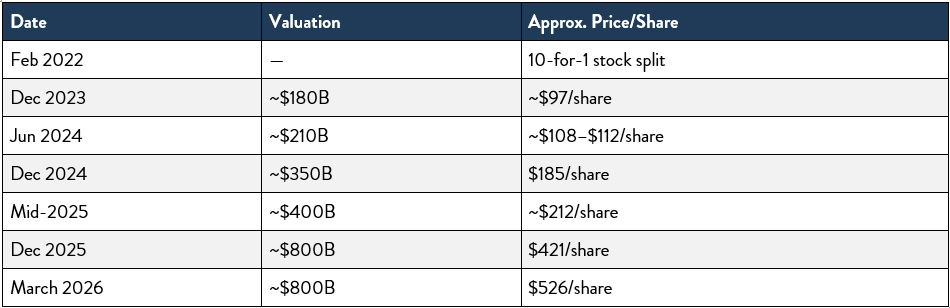
The fair market value (FMV) at the time your RSUs vest determines your taxable income at the state and federal levels. If you received a grant when shares were worth $97, and those shares vest when they’re worth $526, you’re paying ordinary income tax on a $429.59/share gain, whether or not you can sell them.
Note: SpaceX has issued multiple classes of stock over time, and your specific fair market value may differ from headline figures. The key takeaway is directionally the same: as valuations rise, so does the tax impact of each vest or exercise.
Potential Tax Traps for SpaceX Employees
Is your financial team prepared to manage the tax implications of substantial equity compensation?
Trap #1: RSU Vesting With No Liquidity
Let’s say Jordan, a Senior Engineer in Hawthorne, received 5,000 RSUs in 2022 when SpaceX’s FMV was $56/share (post-split). SpaceX RSUs vest in tranches, so in 2025, 1,000 of those shares vest at $212/share. That’s $212,000 of W-2 income on shares Jordan can’t sell on the open market (yet). Over the full 5-year schedule, the complete grant is worth $1,060,000, but the tax bill arrives in 10 installments rather than all at once.
SpaceX will withhold taxes on vesting (typically through share withholding), but supplemental wage withholding rates often fall short of the actual tax owed, especially in high-tax states like California. Jordan could owe a significant additional amount come April.
Planning takeaway: Build a cash reserve well before your vesting dates. Don’t assume withholding covers your full liability.
Trap #2: ISO Exercise and AMT
This is an area where seemingly small decisions become very expensive.
If you hold ISOs and exercise them, the spread between your strike price and the current FMV is an AMT preference item. With SpaceX’s FMV jumping from ~$97 to $526 in two years, exercising even a modest ISO grant can trigger a six-figure AMT bill.
The IRS treats this as taxable compensation for AMT purposes, even though you haven’t sold anything. You may be able to recover AMT credits in future years, but the cash outlay is real and immediate.
Planning takeaway: If you hold ISOs, model the AMT impact at several FMV scenarios before exercising. In some cases, spreading exercises across multiple years can help manage AMT. However, in a rapidly rising valuation environment, delaying exercises can increase your tax exposure to unmanageable levels. As FMV increases, so does the AMT on each exercise, and the compounding effect can outweigh the benefit of deferral. Exercising earlier when the spread is smaller may result in lower AMT.
If you carry an AMT credit forward, track your adjusted basis carefully and ensure credit is being applied each year.
Trap #3: Multi-State Tax Complexity
SpaceX has employees across California, Texas, Washington, Florida, and beyond, many of whom have worked in more than one state. California taxes equity based on where you earned it, not where you live when it vests.
If you worked in Hawthorne for 3 years, then transferred to Starbase in Texas, California will still claim a portion of your equity income based on the time you spent working in-state. Moving to a no-income-tax state doesn’t erase your California tax obligation on equity earned there.
Planning takeaway: Track your work location history carefully. If you’ve worked in multiple states, you need a multi-state tax strategy, not just a federal one.
Refresher: How Your SpaceX Equity Works
Because SpaceX is currently private, you cannot freely sell your shares yet. That all may change in the coming months. Here’s what you’re likely holding.
Restricted Stock Units (RSUs)
These are SpaceX’s version of RSUs. You receive a grant of units that convert to Class C non-voting stock upon vesting, under the Equity Incentive Plan originally approved in March 2015. The key difference from a public company: when your RSUs vest, you own real shares but have no liquid market to sell them. Your RSU tax obligations still kick in at vesting.
Post-IPO: Vested RSUs become publicly tradable shares once lockup restrictions expire. Unvested units typically convert into equivalent RSUs of the public company and continue vesting on the original schedule.
Incentive Stock Options (ISOs)
These give you the right to purchase shares at a locked-in strike price. ISOs receive favorable long-term capital gains treatment if you meet the holding period requirements: hold the shares for at least one year after exercise and two years after grant.
The catch? The spread between your strike price and fair market value at exercise is an Alternative Minimum Tax (AMT) preference item. With SpaceX’s valuation rising so sharply, an ISO exercise can trigger a large cash tax bill before you have any liquidity to cover it. With SpaceX’s valuations skyrocketing, that AMT bill could be substantial.
Post-IPO: Your options remain options. After exercising and satisfying any lockup restrictions, the resulting shares can be sold on the open market. The same ISO tax rules still apply.
Non-Qualified Stock Options (NSOs)
NSOs function similarly to ISOs, but their tax treatment differs. The spread at exercise is taxed as ordinary income, meaning the tax bill is triggered immediately. While this avoids AMT complexity, it also means the shares do not qualify for the favorable long-term capital gains treatment available to ISOs.
How ISOs can become NSOs: Employees who elect a cashless exercise during a SpaceX tender offer should be aware that doing so converts the entire option award from an ISO to an NSO, regardless of whether the option is exercised in full or in part. This means the favorable ISO tax treatment, including potential AMT deferral and long-term capital gains eligibility, is permanently lost.
The $100,000 ISO limit: ISOs only receive favorable treatment on up to $100,000 of options (by grant-date FMV), becoming exercisable per calendar year. Anything above that threshold is automatically reclassified as NSOs. With large SpaceX grants, this limit is easy to hit. Confirm your ISO classification with a tax advisor before exercising.
Post-IPO: Once exercised and past the lockup period, the shares can be sold on the public market. Any additional appreciation after exercise is taxed as capital gains.
Employee Stock Purchase Plan (ESPP)
SpaceX offers the ability to purchase shares at a discount through payroll deductions. If you’re not participating, you may be leaving discounted shares on the table.
Post-IPO: Purchased shares become publicly tradable after the lockup period. If holding requirements are met, a portion of the gain may qualify for long-term capital gains treatment.
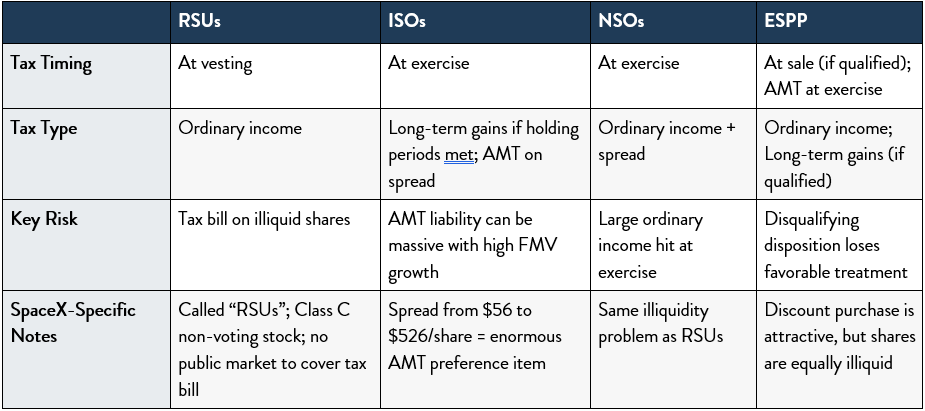
The big picture: Every instrument vests differently, triggers taxes differently, and demands a different post-IPO strategy. Knowing what you hold is step one.
SpaceX Equity Compensation: Comparison Table
What a Liquidity Event Means for Your Taxes
If SpaceX goes public, the tax landscape will shift dramatically. Familiarize yourself with how these rules may impact you:
Short-term vs. long-term capital gains. Shares held for more than one year after vesting (for RSUs) or exercise (for options) qualify for long-term capital gains rates (currently 15%, or 20% depending on income). Shares sold within one year are taxed as ordinary income. The difference can be 13+ percentage points on your tax rate.
Lockup periods. In a typical IPO, insiders can’t sell for 90-180 days. You’ll be watching the stock price move with no ability to act. This is why pre-IPO planning matters: your tax strategy and diversification targets should already be set before the lockup begins.
Wash sale rules. If you’re selling shares post-IPO while also buying through ESPP, beware. Selling at a loss and repurchasing substantially identical shares within 30 days triggers wash sale rules, disallowing the loss deduction.
ISO holding periods. For ISOs to receive qualified disposition treatment (long-term capital gains), you must hold the shares for at least one year after exercise AND two years after the grant date. Selling earlier triggers a disqualifying disposition, and the spread gets taxed as ordinary income.
Your move: Start tracking your holding periods now. When the window opens, you’ll want to know exactly which lots qualify for favorable treatment and which don’t.
Your Pre-Liquidity Checklist
- Audit your equity inventory. Know exactly what you hold: RSUs, ISOs, NSOs, ESPP shares. Document vesting dates, strike prices, grant dates, and current FMV.
- Model your tax exposure. Run projections at multiple FMV scenarios. What do you owe if shares are worth $400/share? $600? $800? Stress-test your cash position against each scenario.
- Develop an ISO exercise strategy. If you hold ISOs, consider whether a phased exercise approach makes sense to manage AMT across multiple tax years.
- Set aside cash for taxes. Build reserves for federal, state, and potential multi-state obligations.
- Review your ESPP participation. If you’re not contributing the maximum allowed, you may be passing up discounted shares. Run the numbers on whether increasing your contribution makes sense.
- Read your stock agreement. With an IPO on the horizon, understanding your transfer restrictions, repurchase rights, and post-departure timeline is crucial.
- Build a diversification plan. Decide in advance what percentage you will sell versus hold when liquidity arrives, and what vehicles will provide the most tax protection.
TAKE THE NEXT STEP
Schedule a no-obligation consultation with Summitry to learn more about how we can help you navigate the upcoming SpaceX IPO.
Frequently Asked Questions
Can I make a Section 83(b) election on my SpaceX RSUs?
No. Section 83(b) elections apply to restricted stock (actual shares), not restricted stock units. RSUs are a promise to deliver shares in the future, so the 83(b) election isn’t available. This is a common misconception. The election is only relevant if you receive actual restricted shares that are subject to a vesting schedule.
What happens to my unvested RSUs if SpaceX goes public?
Typically, unvested equity converts into equivalent units of public company stock and continues vesting on the original schedule. However, some IPO scenarios include acceleration provisions. Check your grant agreement for any change-of-control language. Don’t assume acceleration; plan as if your vesting schedule stays the same.
Can my spouse receive SpaceX shares in a divorce settlement?
SpaceX’s ROFR and transfer restrictions make dividing equity in a divorce complicated. Shares generally can’t be transferred directly to a non-employee spouse. Courts may assign a value and offset it with other assets, or order you to sell through a tender offer and split the proceeds. Both a family law attorney and a financial advisor should be involved early on.
If I move from California to Texas mid-vesting, do I owe California taxes on all my equity?
Not all of it, but likely a portion. California uses an allocation method based on the number of working days you spent in California during the period between your grant date and vesting date. So if you worked 3 of 4 vesting years in California, roughly 75% of your vesting income is California-sourced. The Franchise Tax Board is aggressive about pursuing this.
Do secondary market sales (Forge, EquityZen) trigger different tax treatment than tender offers?
The tax treatment is generally the same: you’re selling shares and recognizing a gain or loss. The practical differences are in pricing (secondary markets may offer different prices than SpaceX’s tender offer) and the ROFR complication. If SpaceX exercises its ROFR, the transaction terms may change. Also, secondary market platforms charge fees (typically 3-5%) that reduce your net proceeds. Factor that into your comparison.
What’s the risk of holding too long after an IPO?
Concentrated stock positions are one of the biggest wealth risks in the tech sector. History is full of examples: employees who held through lockup expiry, watched the stock climb, and then saw it drop 50-70% before acting. A diversification plan created before the IPO removes emotion from the equation. Decide your sell targets in advance and stick to them.
DOWNLOAD THIS GUIDE
Click here to download this guide.
This material is intended for general informational purposes only, and should not be construed as legal, tax, investment, financial, or other advice. It does not consider the specific investment objectives, tax and financial condition or needs of any specific person. To the extent that this material concerns tax matters, it is not intended or written to be used, and cannot be used, by a taxpayer for the purpose of avoiding penalties that may be imposed by law. Investing involves the risk of loss, including loss of principal. Consider engaging an accountant to ensure you understand the tax implications when making investment decisions. The securities identified and described do not represent all of the securities purchased, sold or recommended for client accounts. The reader should not assume that an investment in the securities identified was or will be profitable.
Summitry, LLC is a registered investment advisor in the State of California. For more information about Summitry, including fees and services, please see our Form ADV Part 2A or contact us directly.
GET THE NEXT SUMMITRY POST IN YOUR INBOX: